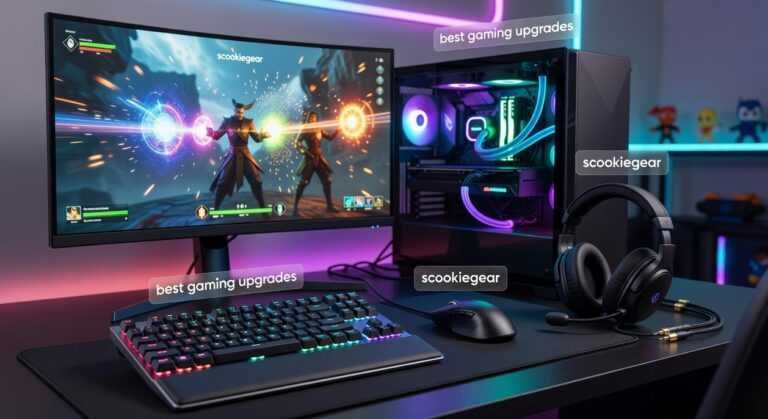
Gaming technology continues to evolve, giving players more ways to improve their performance, comfort, and overall gaming experience. Whether you enjoy competitive shooters, open-world adventures, racing games, or casual gaming, choosing the right upgrades can make a noticeable difference.
ScookieGear gaming upgrades is a topic for gamers interested in improving their setups with better hardware, accessories, and performance enhancements. The right upgrade depends on your current equipment, the games you play, and your budget.
1. Upgrade Your Graphics Card (GPU)

The graphics card is one of the most important components in a gaming PC. It handles rendering, visual effects, textures, and much of the graphical workload in modern games.
A more powerful GPU can provide:
- Higher frame rates in demanding games.
- Improved graphics quality and visual details.
- Better performance at 1440p and 4K resolutions.
- Support for advanced features such as ray tracing, depending on the model.
- Smoother gameplay when paired with a suitable processor and monitor.
Before purchasing a new graphics card, check your power supply, case dimensions, motherboard compatibility, and processor performance. A high-end GPU may offer limited benefits if another component is holding back your system.
2. Choose a High-Refresh-Rate Gaming Monitor

A gaming monitor directly affects how smoothly you see movement on the screen. Standard 60Hz displays refresh 60 times per second, while 144Hz and 240Hz monitors can display considerably more frames per second.
Here are some common monitor specifications:
| Refresh rate | Suitable use |
|---|---|
| 60Hz | Casual gaming and everyday tasks |
| 144Hz | General gaming and competitive play |
| 165Hz | Smooth gameplay across many game genres |
| 240Hz | Fast-paced competitive gaming |
| 360Hz | Competitive gaming where very high frame rates are achievable |
Resolution also matters. A 1080p monitor is generally less demanding on your graphics card than a 1440p or 4K display.
For many gamers, a 144Hz or 165Hz monitor with a suitable resolution provides a practical balance between visual quality, performance, and cost.
3. Invest in a Responsive Gaming Mouse

A gaming mouse is particularly important for first-person shooters, real-time strategy games, and other titles requiring accurate movement.
Important features include:
- Sensor accuracy: A reliable optical sensor helps deliver consistent tracking.
- Adjustable DPI: Allows players to customize pointer sensitivity.
- Ergonomic design: A comfortable shape can reduce hand fatigue.
- Lightweight construction: May make quick movements easier for some players.
- Programmable buttons: Useful for shortcuts and customized controls.
A mouse with a high DPI rating is not automatically better. Comfort, consistent tracking, and personal preference are usually more important than the maximum advertised sensitivity.
4. Upgrade to a Mechanical Gaming Keyboard

A mechanical keyboard can improve the typing and gaming experience through individual mechanical switches beneath its keys.
Common switch types include:
- Linear switches: Smooth keystrokes without a tactile bump.
- Tactile switches: Provide noticeable feedback when pressed.
- Clicky switches: Produce both tactile feedback and an audible clicking sound.
Other useful features include anti-ghosting, N-key rollover, customizable lighting, dedicated media controls, and programmable keys.
A compact keyboard may also provide more room for mouse movement, particularly in competitive games. However, the ideal layout depends on your typing habits and preferred games.
5. Improve Your Gaming Headset and Audio

Audio quality can make games more immersive and help players identify important sound cues.
A good gaming headset should offer:
- Clear sound for dialogue, effects, and music.
- Comfortable ear cushions for extended sessions.
- A reliable microphone for multiplayer communication.
- Good directional audio for games where sound positioning matters.
- Wired or low-latency wireless connectivity.
Virtual surround sound and spatial audio can be useful, but their effectiveness varies by game and headset. A comfortable stereo headset with clear sound can be sufficient for many players.
6. Upgrade Your RAM

Random access memory (RAM) temporarily stores data that your computer needs while running games and applications.
Insufficient RAM can cause stuttering, slowdowns, and problems when multiple applications are open.
| RAM capacity | Typical use |
|---|---|
| 8GB | Basic gaming and older titles |
| 16GB | General gaming and everyday multitasking |
| 32GB | Modern gaming, streaming, and multitasking |
| 64GB | Heavy multitasking and specialized workloads |
For many modern gaming PCs, 16GB is a practical starting point, while 32GB offers additional room for demanding games and background applications.
Before upgrading, check your motherboard’s supported memory type, maximum capacity, and configuration. Installing a matched memory kit can help ensure compatibility.
7. Install an SSD for Faster Loading

Storage upgrades are particularly useful for computers that still rely on traditional hard drives.
An SSD can provide several benefits:
- Faster operating system startup.
- Shorter game loading times.
- Quicker file transfers.
- More responsive application performance.
- Less noise because SSDs have no moving mechanical parts.
There are two common SSD types: SATA SSDs and NVMe SSDs. NVMe drives can deliver substantially higher transfer speeds, although the real-world difference depends on the task and system.
A 1TB SSD is a useful capacity for many gaming setups, particularly if you install several large games.
8. Improve Your PC Cooling System

Cooling is essential for maintaining stable performance during demanding gaming sessions.
When a processor or graphics card becomes too hot, it may reduce its operating speed to manage temperatures. Effective cooling can help prevent this thermal throttling.
Common cooling improvements include:
- Adding case fans for better airflow.
- Cleaning dust filters and internal components.
- Installing a suitable CPU air cooler.
- Considering liquid cooling for compatible high-performance systems.
- Improving cable management to reduce airflow obstruction.
An expensive liquid cooling system is not necessary for every gaming PC. A properly installed air cooler and well-ventilated case can provide excellent results for many users.
9. Create a Comfortable Gaming Setup

Comfort is another important part of a gaming setup. An ergonomic chair, suitable desk, and correctly positioned monitor can make longer gaming sessions more comfortable.
Consider the following improvements:
- Ergonomic chair: Look for adjustable seat height, back support, and comfortable cushioning.
- Adjustable desk: Choose a stable desk with sufficient space for your monitor, keyboard, and mouse.
- Monitor arm: Position the display at a comfortable height and viewing distance.
- Large mousepad: Provide sufficient space for consistent mouse movement.
- Lighting: Use comfortable room lighting to reduce glare and visual distractions.
Taking regular breaks and changing your posture are also useful habits, regardless of how expensive your gaming equipment is.
10. Improve Your Internet Connection

Online gaming performance depends partly on network quality. Even a powerful gaming computer can experience interruptions when the connection is unstable.
Useful network upgrades include:
- Using an Ethernet cable for a more consistent connection.
- Upgrading an outdated router when it limits your network performance.
- Positioning your Wi-Fi router away from major obstructions.
- Using a suitable Wi-Fi band for your environment.
- Reducing unnecessary network congestion.
Remember that internet speed and latency are different measurements. A faster download speed does not automatically mean lower ping. For competitive online games, a stable connection with low latency is often more useful than extremely high download speeds.
Which Gaming Upgrades Should You Prioritize?
The best upgrade depends on the problem you are trying to solve.
| Your current problem | Upgrade to consider |
|---|---|
| Low FPS | Graphics card or processor |
| Choppy visuals | High-refresh-rate monitor or performance improvements |
| Slow game loading | SSD |
| Frequent stuttering | RAM, CPU, or storage investigation |
| Poor aiming control | Gaming mouse and mousepad |
| Unclear in-game audio | Better headset |
| High temperatures | Cooling and airflow |
| Unstable online matches | Network troubleshooting or Ethernet |
| Discomfort during long sessions | Chair, desk, and monitor positioning |
Gaming Upgrade Budget Planning
Rather than purchasing every component at once, divide your budget according to your needs.
Example upgrade budgets
Illustrative allocations, not current product prices
Budget setup
$100–$250
SSD or RAM upgrade
Gaming mouse or headset
Basic desk improvements
Mid-range setup
$250–$600
144Hz or 165Hz monitor
Suitable GPU or RAM upgrade
Keyboard and audio improvements
High-performance setup
$600+
Graphics card or platform upgrade
High-resolution, high-refresh-rate monitor
Cooling and other supporting components
These categories are starting points rather than fixed recommendations. A graphics card upgrade may consume most of a high-performance budget, while someone with an already powerful PC may benefit more from a monitor or peripheral upgrade.
Common Gaming Upgrade Mistakes to Avoid
Buying expensive equipment does not automatically improve gaming performance. Avoid these common mistakes:
- Purchasing components without checking compatibility.
- Spending on RGB lighting before addressing performance problems.
- Buying a powerful GPU that is limited by the rest of the system.
- Ignoring the power supply’s capacity and quality.
- Choosing a monitor with specifications your PC cannot take advantage of.
- Assuming higher DPI or polling rates always provide a meaningful advantage.
- Replacing working hardware without identifying an actual performance limitation.
Checking system performance before shopping can help prevent unnecessary spending.
Final Thoughts
The best gaming upgrades discussed in the ScookieGear topic include graphics cards, high-refresh-rate monitors, gaming mice, mechanical keyboards, headsets, SSDs, RAM, cooling systems, and ergonomic accessories.
Each upgrade serves a different purpose. A graphics card can improve visual performance, an SSD can reduce loading times, and a suitable monitor can make gameplay appear smoother. Meanwhile, reliable peripherals and a comfortable environment can improve the overall gaming experience.
The most effective approach is to identify your current system’s limitations, prioritize the upgrades that address them, and make changes gradually. This helps you build a gaming setup that matches your needs without spending money on features you may never use.